Worcester's glove-making industry once employed nearly half the glovers in England. At its height, the city produced half the gloves in Britain and exported them worldwide.
From Medieval Guild to Global Powerhouse
The glove-making trade in Worcester traces its roots to the medieval period. The Glovers and Pursers Guild received its royal charter of incorporation in 1497, establishing the craft as an organised local trade centuries before industrialisation transformed it.
The industry remained modest until the later 18th century, when Worcester began its transformation into a major manufacturing centre. By 1830, the city supported 108 glove manufacturers. This figure rose to more than 150 firms by the late 19th century, making Worcester the undisputed heart of British glove production.
The Allcroft Era and World Dominance
The most significant development came in 1777, when John Dent founded what would become the world's premier glove manufacturer. Dents began as a modest Worcester workshop but expanded dramatically after John Derby Allcroft joined the firm in 1847, forming Dent, Allcroft & Co.
Under Allcroft's leadership, annual production quadrupled. By 1884, the company manufactured over 12 million pairs of gloves annually. This output made Dents not merely Britain's largest glove producer but the world's.
The scale of Worcester's industry was staggering. At its peak, the sector employed more than 30,000 people in the Worcester area alone, representing nearly half of all glovers in England.
From Factory Floor to Royal Court
Worcester's glove-makers served clientele far beyond the high street. Dents held royal warrants and supplied gloves to Lord Nelson and Queen Victoria. The company's archives preserve patterns dating to 1839, still in use today.
The royal connection continued into the 20th century. Emil Rich, a Jewish refugee from Germany who founded the Milore Glove Factory in Worcester during the 1940s, designed and manufactured the coronation gloves for Queen Elizabeth II in 1953.
The Decline
The industry's dominance proved vulnerable. The late 19th century brought the first serious challenge when import taxes on foreign competitors, chiefly from France, were substantially reduced. This policy shift allowed continental manufacturers to undercut Worcester prices.
The mid-20th century accelerated the decline. Gloves became less fashionable as everyday attire, while free trade policies enabled cheaper mass production in the Far East. By the late 20th century, only three Worcester firms remained: Dent Allcroft, Fownes, and Milore.
The Glover's Needle: A City's Memorial
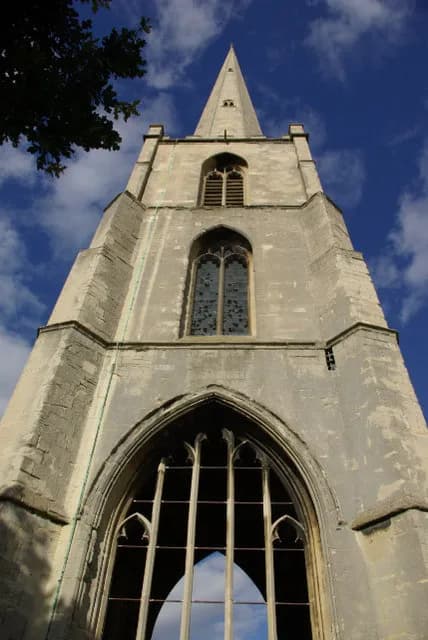
Worcester's tallest structure stands as permanent tribute to the trade that built its industrial reputation. The Glover's Needle, the 74.7-metre spire of the former St Andrew's Church, takes its affectionate nickname from the city's glove-making heritage.
The tower dates from the 15th century, though the distinctive spire was rebuilt in 1751 by Nathaniel Wilkinson. When the church was demolished in 1949, the spire was preserved, becoming a landmark synonymous with Worcester's industrial past.
What Remains
The Worcester City Art Gallery & Museum, established in 1833, maintains collections documenting the city's industrial history, including its glove-making heritage. Dents continues operations, its museum preserving gloves worn by figures from Lord Nelson to Queen Victoria and coronation gloves for George VI and Elizabeth II.
The Glovers and Pursers Guild, incorporated over five centuries ago, maintains its presence in Worcester. The needle that gives the city its tallest monument still points skyward, marking an industry that once, quite literally, held the world in the palm of its hand.