In October 1216, as England convulsed in civil war and foreign invasion, King John lay dying at Newark Castle in Nottinghamshire. His final request was specific: he wished to be buried not at Westminster or Winchester, but at Worcester Cathedral, between the shrines of two Saxon saints.
A Death in Newark
King John died on 19 October 1216, succumbing to dysentery after a reign marked by the loss of Normandy, conflict with his barons, and the sealing of Magna Carta. The circumstances of his death have become the stuff of legend; popular accounts speak of a "surfeit of peaches" or poisoned ale, though contemporary chroniclers record only the illness itself.
What is documented is his will. The original document, now the oldest surviving royal will in England, resides in the Cathedral Library at Worcester. In it, John stipulated his burial place with precision: Worcester Cathedral, at the heart of the Anglo-Saxon shrine network that had drawn pilgrims for centuries.
Why Worcester?
The choice was not arbitrary. John had formed a connection with Worcester during his reign; he spent Christmas 1214 there, and the cathedral had become a place of personal significance. But his selection went beyond mere affection for the city.
John requested burial between the shrines of St Wulfstan and St Oswald. St Wulfstan, who died in 1095, was one of the most revered saints in medieval England; so powerful was his shrine that Henry II and Eleanor of Aquitaine had visited in 1158, vowing never to wear their crowns again. St Oswald, Archbishop of York and Bishop of Worcester, who died in 992, lent his name to another major pilgrimage site.
By placing himself between these two holy men, John was seeking more than proximity to local saints. He was aligning himself with the spiritual protectors of England, perhaps hoping that their intercession might offer what his reign had not: peace, legitimacy, and salvation.
The Tomb Today
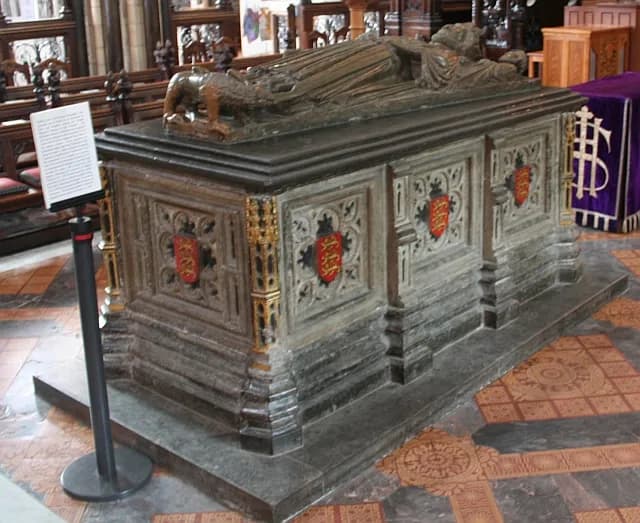
Visitors to Worcester Cathedral find King John's tomb in a place of honour before the High Altar. The tomb is crafted from dark Purbeck marble, surmounted by an effigy that carries particular distinction: it is the oldest surviving royal effigy in England.
The carving displays the Plantagenet badge of three lions, though heraldic purists note they are technically leopards, positioned in the traditional passant guardant stance. The effigy depicts John in regal pose, a crown upon his head, his hands joined in prayer.
The saints' shrines that flanked him have not survived the centuries; both were destroyed during the Reformation. Yet John's tomb endured, perhaps spared by its royal status, perhaps by the simple passage of time.
A Royal Connection Continued
John is the only medieval monarch buried in Worcestershire, a fact that gives Worcester Cathedral a unique place in England's royal geography. His son, Henry III, visited his father's tomb and became a significant benefactor of the cathedral, strengthening the bond between the Crown and this provincial church.
That connection continues in the cathedral's collections. Alongside John's will, the library holds a 1225 copy of Magna Carta, the document that defines the limits of royal power and stands as perhaps the most significant legacy of John's troubled reign.
Worcester's Royal Heritage
For Worcester residents, King John's tomb offers a tangible link to the nation's medieval history. While Westminster Abbey houses a parliament of monarchs and Windsor its share of royal tombs, Worcester can claim something rarer: a king who chose this city not through accident of birth or political calculation, but through personal devotion.
The tomb remains open to visitors, its effigy still watched over by the cathedral's medieval stonework. In death, as he never quite achieved in life, King John found a peaceful resting place in the city he had grown to love.