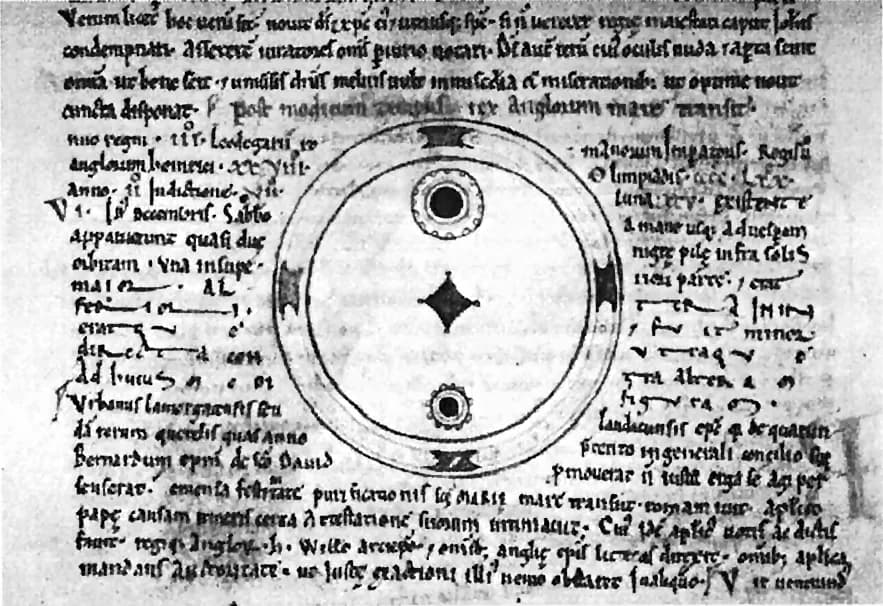
On 8 December 1128, a monk working in the scriptorium at Worcester Priory put down his pen after completing a chronicle entry and turned his attention to the sky. What he saw that day, and what he drew in the margin of his manuscript, would not be recognised for its significance for nearly nine centuries. The monk was John of Worcester, and his drawing is now acknowledged as the earliest known image of a sunspot from anywhere in the world.
A Monk at Worcester Priory
John of Worcester entered the Benedictine monastery at Worcester as a boy and spent his life in the monastic community that would eventually become Worcester Cathedral. He won recognition for his learning and piety, and at the command of Bishop Wulfstan, who died in 1095, he undertook the compilation of a world history. The result was the Chronicon ex Chronicis (Chronicle from Chronicles), a vast work beginning with the Creation and extending to 1140, the year of John's death.
Worcester Priory was a centre of intellectual life in medieval England. Its scriptorium produced numerous manuscripts, and its library holdings today include 289 medieval volumes. The monastic community, dedicated to St Mary and maintaining shrines to St Wulfstan and St Oswald, was a place of pilgrimage and learning. John worked within this environment, drawing on sources including Bede, Asser, and the Anglo-Saxon Chronicle to construct his chronicle.
The Drawing in the Margin
The sunspot drawing appears on page 380 of MS 157, the principal manuscript of John's chronicle, now held at Corpus Christi College, Oxford. The image shows dark spots on the face of the Sun, rendered with enough accuracy that modern astronomers can recognise the phenomenon. John made this observation nearly five hundred years before Galileo Galilei turned his telescope toward the Sun in 1612.
How John observed the Sun safely remains a matter for speculation. Medieval astronomers may have used smoked glass or projection methods to view solar phenomena without damaging their eyes. What is certain is that John was recording a genuine astronomical event during a period of high solar activity known as the solar maximum.
Rediscovery by Modern Scholars
The significance of John's drawing was not recognised until 1999, when astronomers F. Richard Stephenson and David M. Willis published their findings in the journal Astronomy & Geophysics. Their article, "The earliest drawing of sunspots," established that the Worcester monk's illustration predates all other known sunspot drawings. The Royal Astronomical Society publication brought medieval astronomical observation into modern scientific discourse.
Five days after John's observation, on 13 December 1128, Korean astronomers recorded seeing the northern lights. This conjunction of events, a sunspot followed by an aurora, represents one of the earliest documented connections between solar activity and terrestrial effects. The Worcester observation and the Korean aurora together constitute the first known prediction of what scientists now call a coronal mass ejection.
Worcester's Scientific Heritage
The drawing connects Worcester to the history of observational astronomy in a direct and tangible way. While the manuscript itself now resides in Oxford, it was created in the scriptorium at Worcester Priory, now Worcester Cathedral. The cathedral's monastic library, refounded along Benedictine lines around 966, produced many notable manuscripts. Another famous Worcester scribe, known to scholars only as "The Tremulous Hand of Worcester," worked in the thirteenth century and annotated numerous volumes.
Today, visitors to Worcester Cathedral walk through the site where John of Worcester lived and worked. The manuscript containing his sunspot drawing remains accessible to researchers, and the image itself has entered the public domain, available for anyone to view. What began as a marginal illustration in a monk's chronicle has become a document of scientific importance, demonstrating that systematic observation of the natural world was taking place in medieval English monasteries.
The drawing serves as a reminder that Worcester's contribution to intellectual history extends beyond its famous porcelain and cathedral architecture. In the early twelfth century, a monk in this city looked up at the Sun, saw something no one had recorded before, and put ink to parchment. That act of observation, preserved for nearly nine hundred years, now stands as a testament to the scientific curiosity that flourished within the walls of Worcester Priory.